
Every June, New Orleans roofers start chasing the same thing: visibility.
Makes sense.
The Atlantic hurricane season runs from June 1 through November 30, and in an average year, the basin sees 14 named storms, 7 hurricanes, and 3 major hurricanes. When storms are on the horizon, homeowners don’t spend hours comparing roofers. They search, click, and call.
Now, Semrush data shows “storm season New Orleans” gets around 1,300 monthly searches. It’s still a relatively attainable keyword, even though every roofer in town is trying to own it.
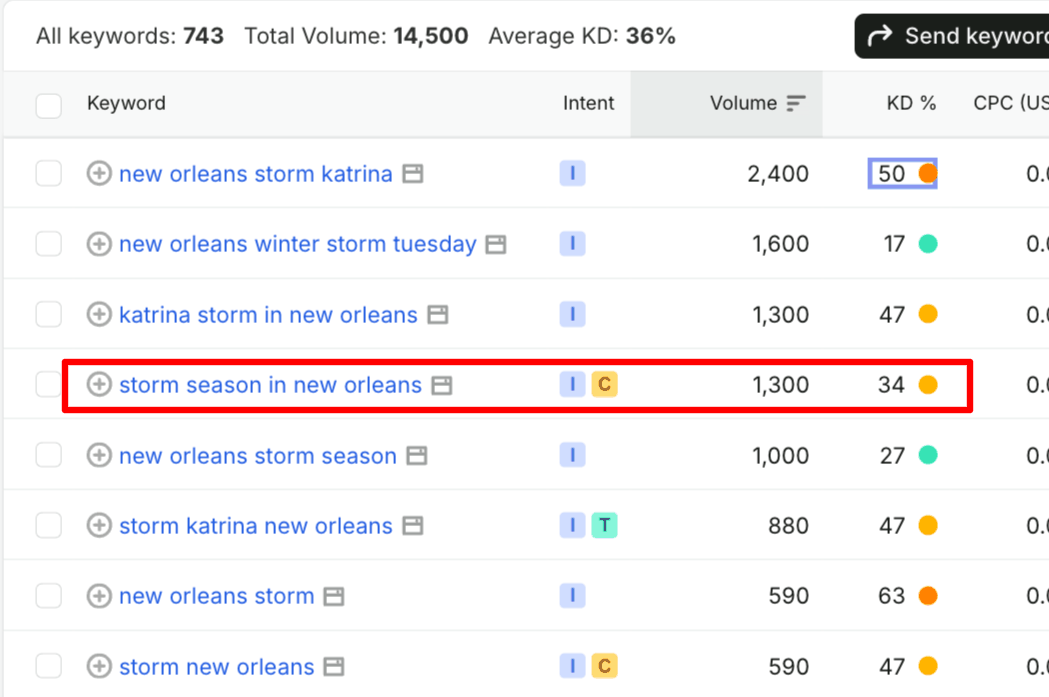
After four years helping roofing businesses build content that ranks during storm season, I’ve noticed something. The winning roofing companies are ahead of time when June arrives.
So let’s make sure you’re one of them.
Why Should NOLA Roofers Create Content Targeting Storm Season?
Nobody in New Orleans is Googling “roof inspection” in February.
But the moment NOAA announces the first named storm, search behavior changes.
Homeowners getting ready for hurricane season search for things like “how to prepare my roof for hurricane season” or “roof inspection before hurricane season.” The morning after a storm rolls through, that same person is searching “emergency roof repair New Orleans” or “roof insurance claim after storm damage.”
If your website answers those questions before your competitor’s does, you’re far more likely to get the click and the call. That’s how storm-season content starts filling your pipeline.
I covered the basics of seasonal SEO in my previous guide, but storm season deserves its own playbook. The timelines are tighter, and the competition is fiercer.
Then there’s insurance. Honestly, it deserves its own section. So it gets one in this guide.
Nola-Based Roofer? Here’s How To Build Your Storm Season Content Strategy in 5 Steps
I am sharing the exact process I use to build storm season content strategies for my roofing clients.
You don’t need a big budget or an agency (if you have a writer on board) to build this strategy. But I would always suggest getting someone who has expertise in SEO to build this out for you.
Meanwhile, if you do want to try building your own, you need a few free tools and a couple of focused afternoons. If you can start in February or March, your content has a good chance of ranking before the weather guy on WWL starts pointing at spaghetti models.
1. Research Storm Season Keywords and Cluster Them
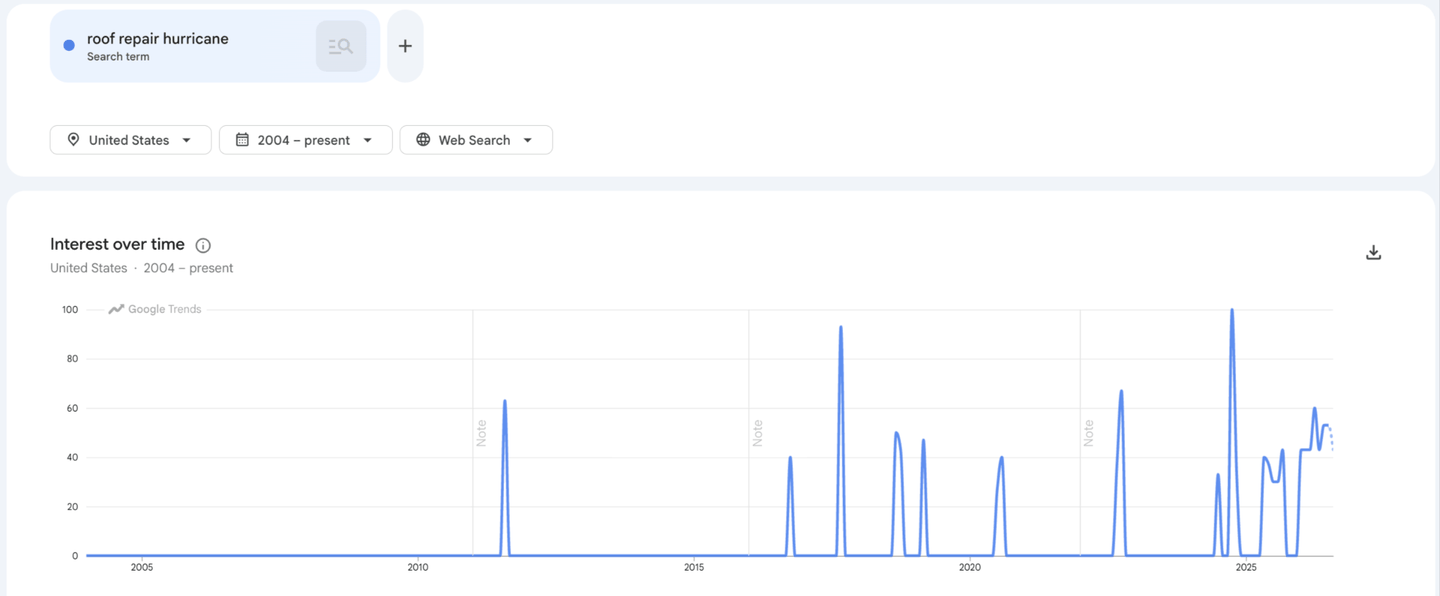
We will start by opening Google Trends and searching for “roof repair hurricane.” You’ll notice the spikes line up almost perfectly with active storm seasons.
That’s your proof that the search demand does exist.
Now we will find every variation of the hurricane keyword.
From what I’ve seen, storm-season searches usually fall into three buckets.
Preparation
Climbs April–May
“roof inspection before hurricane season”
“how to protect your roof from hurricane winds”
Emergency
Explodes within hours of landfall
“emergency roof tarping New Orleans”
“roof leak repair Metairie”
Insurance
Sticks around the longest
“Does homeowners insurance cover wind damage in Louisiana?”
Insurance claims outlive the news cycle.
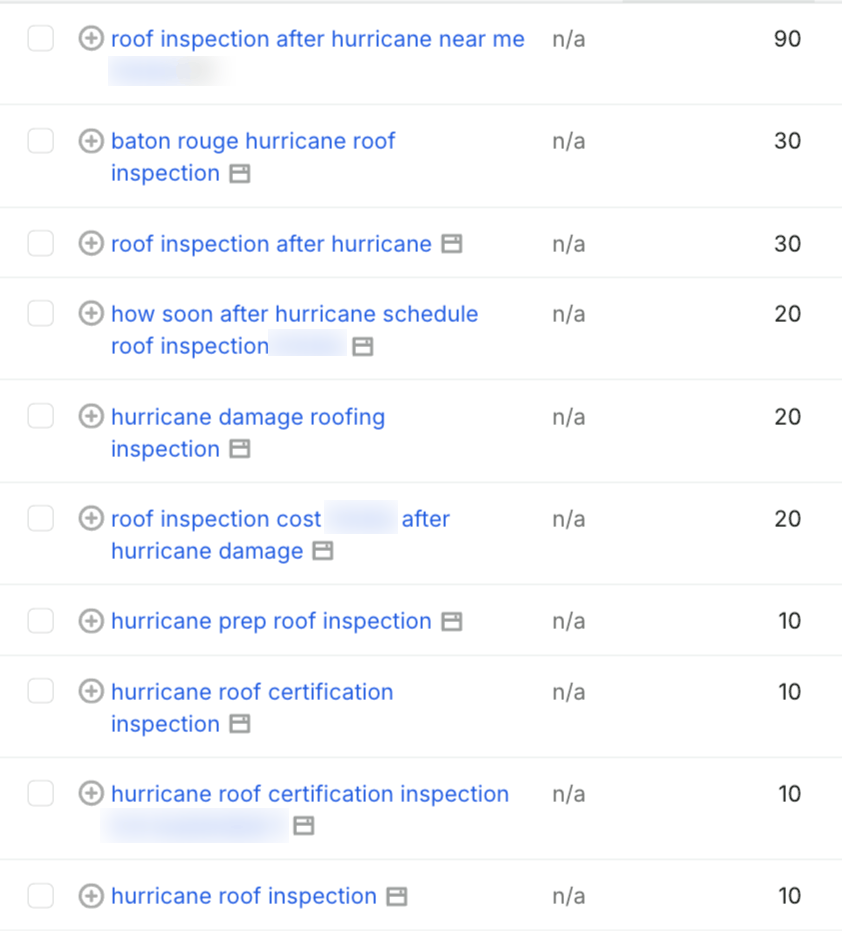
Run each bucket through Semrush or Ahrefs to check search volume. Then compare that data with the language your customers use.
When I worked with roofing clients, I listened to sales calls and read every lead form. I would almost always uncover services people were actively asking for that never appeared anywhere on the website.
If three homeowners asked about Operation Blue Roof last season, that’s worth creating content for — even if Semrush says the keyword has zero search volume.
Your customers will tell you what keyword tools never can.
2. Build a Ranch-Style Strategy (Not a Skyscraper)
The old SEO playbook tells you to write one giant 5,000-word “Ultimate Guide to Hurricane Roof Repair” and hope it ranks for everything.
But personally, ever since I watched Bernard Huang, founder of Clearscope, argue for a smarter approach, I stopped creating skyscraper content. Now I focus on ranch-style content (concept by Bernard). Plainly speaking, it means instead of building one massive page, you build a content silo (network of focused pages) that each answers one question or one small topic/branch.
For a NOLA roofer, that could look like this:
“hurricane roof repair New Orleans”
Where the homeowner converts
What Wind Damage Looks Like
How To Tarp a Roof During Storm
How Long Do Hurricane Roof Repairs Take?
Each blog links back to the service page. The blogs capture homeowners while they’re still researching. The service page is where they convert.
Why does this beat one giant guide?
Because a homeowner in Lakeview with water dripping into a pot at 2 a.m. isn’t looking for a 5,000-word dissertation on roofing. They want the answer to their problem, and Google rewards that kind of specificity. And these days AI search does too. (We’ll get to that in Step 5.)
3. Sequence Your Content: Before, During, and After Storm Season
Timing decides whether any of this works. Publish your prep guide in July and you’ve already missed the window, because Google usually needs a couple of weeks to crawl, index, and rank a new page. If you’re working with a brand-new website, budget even longer, and keep an eye on Google Search Console to see what’s getting picked up.
This is the calendar I follow with roofing clients:
Publish before the season, refresh during it, mine the data after it.
Publish everything
Before the season
- Prep guides and inspection checklists
- Service pages
- Insurance explainers
- Live before NOAA’s late-May outlook
Refresh in real time
During the season
- Watch the NHC, the mayor’s feed, parish pages
- Publish same-day guides when a storm hits
- Embed official updates and emergency contacts
- Push every update on Facebook and Instagram
Collect the data
After the season
- What ranked, and what didn’t
- What people kept calling about
- Questions the site never answered
- Build next year’s calendar from the call log
March and April
Publish everything: prep guides, inspection checklists, service pages, and insurance explainers. NOAA releases its hurricane season outlook in late May, so by the time everyone’s talking about how bad this year might get, your content should already be showing up in search.
June through November
Many marketers will stop writing anything new after publishing their blogs. But that’s where a window of opportunity opens up.
During storm season, I have the National Hurricane Center, the mayor’s feed, and a handful of parish Facebook pages on refresh. Most of these pages will publish new sets of information about the storms. This is usually where the next content opportunity comes from.
A hurricane roof repair guide published the same day a major storm hit a client’s service area — and it ranked almost immediately.
I remember clearly that one of my clients’ main service areas took a direct hit from a major hurricane. They didn’t have a page covering hurricane services because it was a rare event. So we published a hurricane roof repair guide that same day.
The guide had detailed info with tarping steps, what homeowners should expect next, emergency contact numbers, and embedded updates from the mayor’s Twitter account (I refuse to call it X), government agencies, and local news.
It ranked almost immediately because our guide was fresh, detailed, had less competition on the keyword, and sat on a good authority website. We pushed it on Facebook and Instagram too, because during a storm people are constantly scrolling every local group they can find, hoping someone has advice.
That’s the advantage of refreshing content during the season. A page that’s been updated frequently with real-time updates is often more useful than one that’s been sitting untouched for two years.
December through February
Once we have wrapped up the season, I watch the traffic die on these pages. This is where we collect all the data and look at what ranked, what people kept calling about, and which questions the website never answered. Last season’s call log usually makes a better content calendar than any keyword tool.
Roofers who treat this as a yearly cycle stop depending on storm luck. The ones who don’t usually end up paying panic prices for Google Ads (not that it’s a bad thing, but a well-thought-out organic strategy for the win).
4. Position Insurance Claims as a Differentiator
Ask any homeowner who’s been through a hurricane insurance claim what the worst part was. Most won’t tell you it was the roof.
Since Ida, Louisiana’s insurance market has been brutal. A dozen insurers went insolvent, more than $23 billion in claims were paid out after the 2020 and 2021 storms, and homeowners were left navigating an insurance process that was stressful enough before a wave of out-of-state storm chasers showed up.
The National Insurance Crime Bureau even lists manufactured roof damage as one of the most common post-storm fraud schemes. So it’s not a surprise that people are just as cautious about the roofing contractor they hire as they are about the insurance company they’re dealing with.
That’s why “We work with insurance” isn’t much of a differentiator anymore. Every roofing company is saying that.
The better approach is to answer the questions homeowners have while they’re waiting for an adjuster to call them back.
- What does a wind damage claim usually look like in Louisiana?
- What does an adjuster inspect?
- Which photos are worth taking before the tarp goes on?
- What happens if the claim gets denied?
- Which insurance companies has your team worked with before?
Those are the kinds of questions that build trust because they’re useful whether someone hires you or not. By the time a homeowner decides to call, they’ve already spent hours trying to figure this stuff out. If your website is where they figured it out, you’ve done something most roofing websites never bother to do.
You’re a roofer, not a public adjuster, and Louisiana has rules around who can negotiate insurance claims. Explaining the process is fair game. Promising you’ll get someone’s claim approved isn’t.
Ironically, being clear about where your job ends is one of the fastest ways to convince people you’re worth hiring.
5. Compete When AI Gives Generic Answers
Type “how to prepare your roof for a hurricane” into ChatGPT, and you’ll get a perfectly decent checklist. Google’s AI Overviews do something similar before your website even has a chance to earn the click. And those summaries matter now (because they have taken over half the serp real estate).
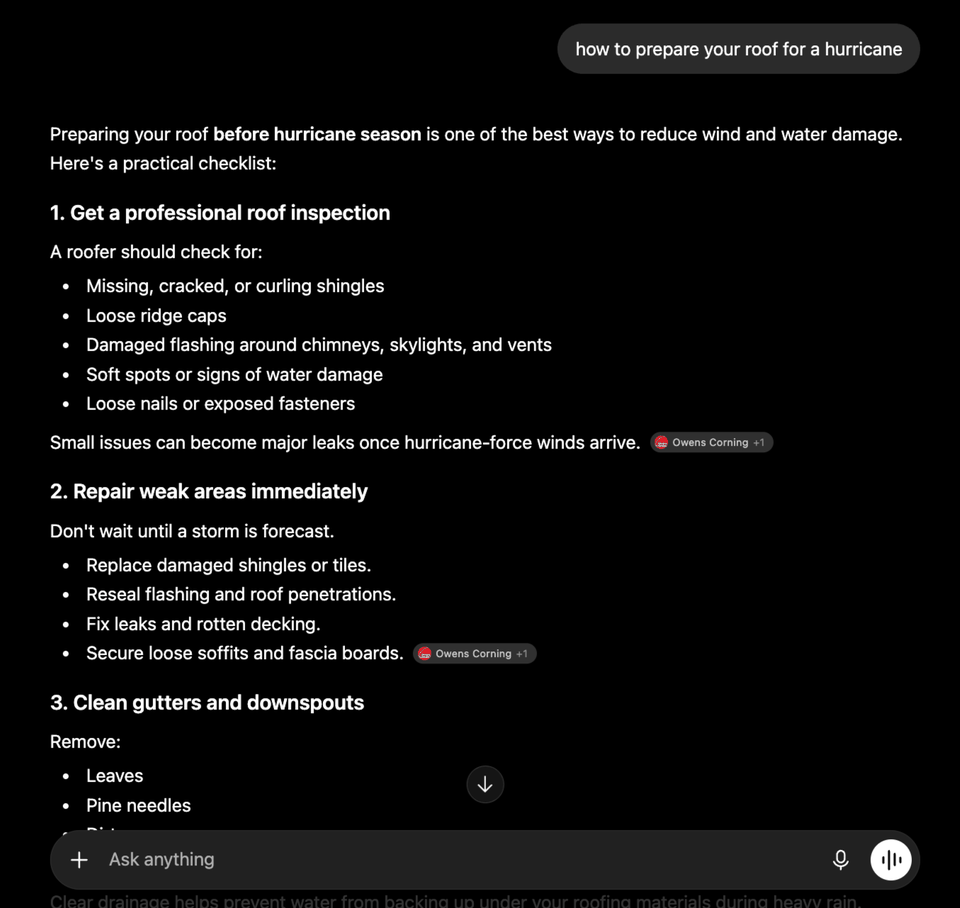
Funnily enough, Pew Research Center watched 900 people actually browse and found the click rate on a normal search result drops to 8% when an AI summary shows up, down from 15% without it.
Now I don’t think AI gives bad advice. After all, it was trained on our own content. The problem is that the same AI answer could apply to someone in Miami, Houston, or New Orleans.
That’s where local businesses like yours still have an edge.
So stop writing pages that could belong to any roofing company in America. Talk about neighborhoods instead of cities. Mention permit delays you’ve dealt with. Explain what homeowners usually get wrong about insurance claims in Louisiana.
If customers keep asking the same question after every storm, answer it on your website. If everyone in Metairie calls it one thing and everyone in Mid-City calls it something else, use both.
And when you do write it up, answer the question quickly instead of making people scroll through three paragraphs of context first. Seer Interactive found brands cited in AI Overviews earned 35% more organic clicks than those that weren’t, so the goal isn’t just to rank below the AI summary anymore. You want your content showing up inside it.
Get More Bookings This Storm Season
I know the strategy looks simple when it’s written on the internet. Find what NOLA homeowners search for before, during, and after storms. Build a service page with supporting blogs around each cluster. Publish by April, and keep it fresh all season.
But this takes up time and energy when you build it out yourself.
If you’d rather spend hurricane season on roofs instead of in Google Search Console, the WTF SEO team builds customized SEO campaigns for New Orleans businesses like yours. Give them a call today!
Spend hurricane season on roofs, not in Search Console.
WTF SEO builds storm-season content strategies for New Orleans roofers — keyword clusters, service pages, supporting blogs, and in-season refreshes — so the calls come to you when the weather turns.
| BusinessWire / Triple-I |
“Triple-I: Louisiana’s Insurance Crisis Grew After 2020-21 Hurricanes.” Business Wire, 28 Mar. 2023, www.businesswire.com/news/home/20230328005675/en/Triple-I-Louisianas-Insurance-Crisis-Grew-After-2020-21-Hurricanes. Accessed 17 Sept. 2026. |
| Clearscope |
Huang, Bernard. “Ranch-Style SEO Content Strategy.” Clearscope, www.clearscope.io/blog/ranch-style-seo-content-strategy. Accessed 17 Sept. 2026. |
| NOAA |
“‘Average’ Atlantic Hurricane Season to Reflect More Storms.” National Oceanic and Atmospheric Administration, 9 Apr. 2021, www.noaa.gov/media-release/average-atlantic-hurricane-season-to-reflect-more-storms. Accessed 17 Sept. 2026. |
| Pew Research Center |
“Google Users Are Less Likely to Click on Links When an AI Summary Appears in the Results.” Pew Research Center, 22 July 2025, www.pewresearch.org/short-reads/2025/07/22/google-users-are-less-likely-to-click-on-links-when-an-ai-summary-appears-in-the-results. Accessed 17 Sept. 2026. |
| Roofing Contractor |
“The Honest Roofer’s Playbook for Post-Storm Trust.” Roofing Contractor, www.roofingcontractor.com/articles/102235-the-honest-roofers-playbook-for-post-storm-trust. Accessed 17 Sept. 2026. |
| Seer Interactive |
“AIO Impact on Google CTR: September 2025 Update.” Seer Interactive, www.seerinteractive.com/insights/aio-impact-on-google-ctr-september-2025-update. Accessed 17 Sept. 2026. |
| Semrush |
Keyword Magic Tool data for “storm season New Orleans” and related hurricane roof inspection terms. Semrush, www.semrush.com. Accessed 17 Sept. 2026. |
| U.S. Army Corps of Engineers |
“Operation Blue Roof.” U.S. Army Corps of Engineers, www.usace.army.mil/Missions/Emergency-Operations/Blue-Roof-Info. Accessed 17 Sept. 2026. |