Everyone and their dog keeps telling you that you need this SEO thing for your business website, and you’re left thinking… “WTF is even that? Sounds like tech wizardry to me, no thank you.” I do not blame you for that perspective at all, honestly. But with around 3.4 billion Google searches taking place across the US every day, chances are SEO does matter to your small business website.
SEO stands for “Search Engine Optimization.” Yep, that does sound technical. And, yep, the practice of SEO does have some technical elements. But I promise that you don’t have to be a marketing expert to get something from this article. I’ve written it specifically for small local business owners, with a ton more going on in their day-to-day than just marketing.
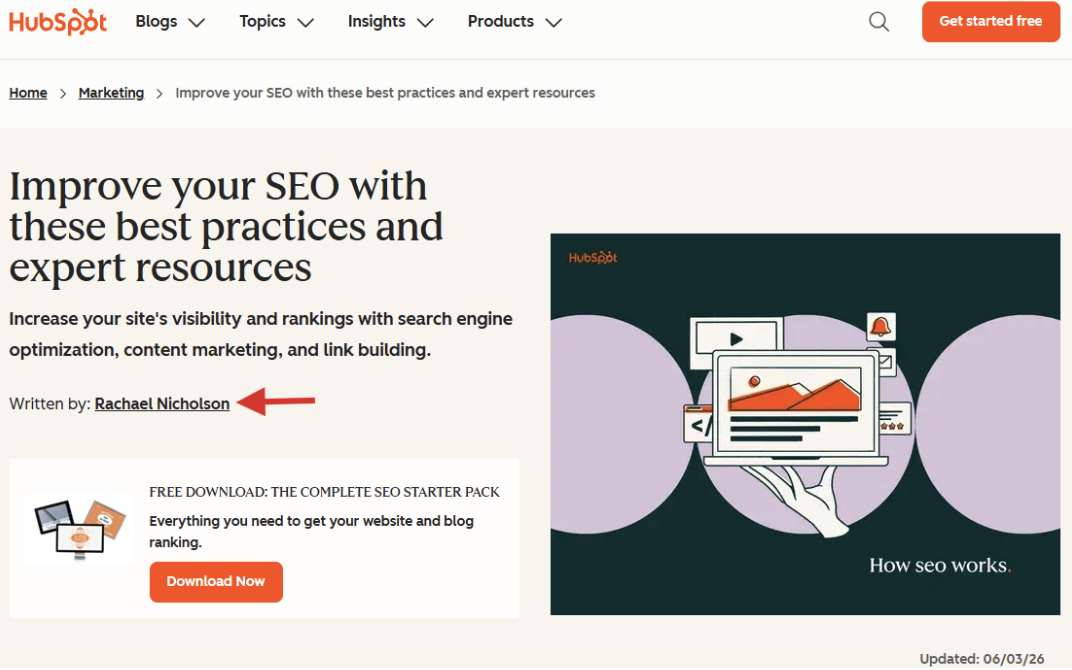
I’ve also spent a large part of my nearly nine years in SEO teaching small business owners like you what SEO is and how it works, and being very transparent about whether folks even need to invest in it at all. And brands like HubSpot and Backlinko have trusted me to educate their audiences about SEO. I’m hoping to help you with that today!
SEO? WTF IS Even That?
Odds are your customers are already searching on Google (or maybe even another search engine like Bing) for the services or products you offer. SEO is how you can match those potential customer searches with the “right” pages on your website. That way, when someone searches for a phrase that’s relevant to your business via a search engine, et voilà! there’s a page from your website ready to greet them.
A homeowner in New Orleans with a burst pipe
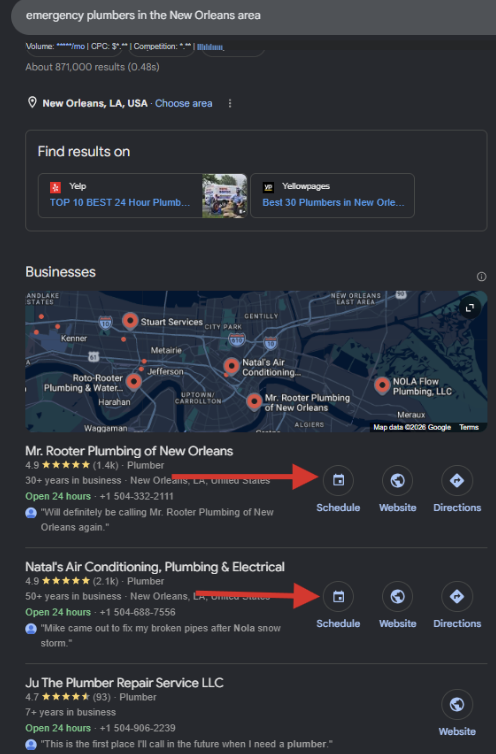
In practice, this might look like a homeowner heading (or more like running!) to Google in search of:
“emergency plumbers in the New Orleans area”
They’re going to need a fix for this home repair, fast. So, if they’re not already writing down numbers at a minimum, they’re probably scheduling an appointment directly from the search engine results. If you want that person’s business, your position in the search results matters.
According to Ahrefs, nearly 97% of US-based desktop clicks happen within the top 10 results. On mobile? It’s even higher, sitting at nearly 98%. In this scenario, our unlucky property owner likely won’t be looking past the first page of Google to find a plumber like you.
Would your company website or Google Business Profile (GBP) even appear on the first page for that search, let alone the top 10 results?
The Pillars of SEO Explained
I don’t want to get too technical or into the weeds here. That said, there are a bunch of cowboys in SEO. I like to call these cowboys “SEbrOs.” And these SEbrOs are not always, but often, looking to sell you a bunch of services you might not actually need.
Even a basic understanding of the following will give you insight into what they may or may not be trying to sell you. That way, you can make an informed choice about whether SEO is right for your business or if you’re faced with a grifter trying to sell you a bridge.
There are a couple of different “pillars” to SEO. The three main ones are:
Technical
Can Google understand your site? By “understand,” I mean can Google interpret the content, its structure, and can it actually crawl the page? If Google’s web crawler can’t crawl a page, it can’t discover it… If it can’t discover a page, it won’t surface it in the search engine results pages (SERPs). That, my friend, is a gigantic roadblock to Google and, more importantly, to your customers finding your content at all.
On-page
Do you have quality content that matches your potential customers’ searches? Let’s say someone based in New Orleans searched “AC repair near me.” Is any part of your website optimized to appear against this search?
Off-page
What’s happening outside of your site? Does it appear naturally in other trustworthy and relevant websites? What are your brand mentions like across social media?
Realistically, not every SEO strategy needs every piece of this puzzle to be “successful.” Not every small local business needs an intense off-page strategy, for example, but if your website isn’t technically sound? And you don’t have many positive reviews on your Google Business Profile? Those factors are more likely to hold you back.
Local SEO Explained
Different types of SEO campaigns work best for different types of businesses and niches… “That’s all well and good, Rachael, but I’m a small, local business in New Orleans. So which one is right for me?” Good point! For local businesses like yours, you’ll likely want local SEO. “Errr ok, but WTF does that actually mean?” You raise another good point…
Local SEO means tailoring your website to match location-specific searches. (The “emergency plumbers in the New Orleans area” example I used above is local SEO in practice.) Because of this, local SEO is aimed at, you guessed it, local businesses that usually (but not always!) have physical premises or locations.
Local SEO strategy usually involves:
- Working with a company’s Google Business Profile. So your business can have more appearances in maps along with increased calls, service bookings, or product purchases.
- Creating website content targeting local searches. So specific pages on your website appear against relevant local searches. (Ideally, that should mean more website visits and increased sales.)
- Making sure a website is technically sound. So A) Google can actually understand it and present web pages against the right customer searches, and B) People using your site have a positive experience that doesn’t make them want to leave and head to a competitor’s website.
Local SEO in action: a Buy Here Pay Here auto dealership that was invisible for bad-credit and local searches doubled its organic traffic in 12 months.
The playbook: technical fixes, automated vehicle schema, local citations, and content built around how buyers actually search. Read the full Auto Approval case study →
Why Do I Need SEO for My Website? (Wait, Do I Even “Need” It?!)
There are around 16.4 billion searches on Google every day, with the United States making up about 21% of all Google traffic. That’s around 3.4 billion US searches daily. If it makes sense for you to operate online, people will be searching for what your business offers. So, the most blatant reason you might need SEO for your website? To appear in front of the right people at the exact moment they’re searching.
Aside from that, there are a few more reasons that could make SEO a solid investment for your local business. However, there are also some instances when SEO probably won’t make much of a difference to you… I want to be candid with you about this, as other SEO professionals (see earlier about the cowboys, AKA the SEbrOs) may not be.
Don’t have a lot of time? No stress. Here’s a quick recap of what’s to come:
| Your situation | Need SEO? |
|---|---|
| People find you on Google, but you’d like to be found more often. | Yes |
| You have seasonal peaks in your business. | Yes |
| You have technical SEO issues on your website or GBP (and you might not even know it! 🫣) | Yes |
| You’re a local New Orleans business, and it makes sense for you to operate online and to compete locally rather than nationally. | Yes |
| Your ideal customer isn’t looking on search engines for the solutions that you offer. So another marketing channel (like social media) might work better for your business. | No |
| You can’t invest enough time, money, or energy into SEO right now. | No |
| You’re looking for “guaranteed” results. (Hint: this is impossible.) | No |
You Probably Need SEO If…
1. People find you on Google, but you’d like to be found more often. If you have a website or a Google Business Profile for your local New Orleans business, and you’re already experiencing demand (website visitors, calls, service bookings, product sales), investing in SEO makes sense because it will help you to maintain and build upon that existing success.
2. You have seasonal peaks in your business. If you notice seasonal trends in your online presence (a boost in website traffic around the holidays, seasonal weather periods, or local events like Mardi Gras, for example), a Seasonal SEO campaign can help you capture even more demand during these times.
3. You might have technical SEO issues on your website or GBP (and you might not even know it! 🫣) If you have a website, but you notice it never appears on Google, the issue could be technical. Maybe Google literally cannot crawl your website. Until that’s fixed, nothing else you do matters. You might have broken links between pages, or pages with no internal links pointing to them at all. Or maybe you have NAP (Name, Address, Phone) inconsistencies (different business details across your online properties) that make it tricky for search engines to show the right business details in the search results. A technical SEO audit can help you find these problems.
4. You’re a local New Orleans business, and it makes sense for you to operate online. In your case, the specific flavor you’ll need is Local SEO. Local SEO will help your small business compete regionally rather than against gigantic national businesses offering the same products or services. If you have physical premises, local SEO will also help potential customers in your area to find you.
You Probably Don’t Need SEO If…
1. Your ideal customer isn’t looking on search engines for the solutions that you offer. Recently, we were lucky enough to interview Liam Fallen. Liam, who has 70,000+ LinkedIn followers, let us pick his brains about what works and what doesn’t when it comes to building a personal brand. Something that he said is highly relevant here:
My advice is always to be wherever your customers are and meet them where they are.
If your target audience isn’t hanging out on search engines, your business probably shouldn’t be either. It could be better for you to invest your marketing budget in social media or attend more in-person business events, as this could deliver higher ROI.
That said, if you’re a local business, especially, it’s still worth your time to at least make sure your Google Business Profile is up to date. And that you have up-to-date, correct contact details across all your online properties, including your GBP, social media pages, and other business directories.
2. You can’t invest “enough” in the channel right now. Don’t get me wrong, some folks (yep, the SEbrOs again) charge a ton of money and don’t even do an acceptable level of work for the most basic of SEO tasks. I don’t condone that approach at all.
However, good SEO isn’t a short-term marketing play, and it does require an investment from you as a business owner. Whether that’s investing your own time and energy if you want to “do it yourself.” Or investing your money (and a bit of your time and energy) if you want to hire a professional to do it for you. If you can’t make those investments, you will likely not see the best results, or any results at all. And that brings me to my next point…
3. You’re looking for “guaranteed” results. The art of SEO is to sway the odds of success (ranking in Google, getting traffic, clicks, and, more importantly, increasing revenue) in your favor. It is literally impossible to guarantee these results, though.
If someone is guaranteeing you SEO results, they might just be an SEbrO. Ranking, traffic, clicks, revenue — no one can promise these outcomes. Anyone who does is selling you a bridge.
Why Do I Need Professional SEO Services? (Wait, Do I Even “Need” Them?!)
If you’re a small, local business in New Orleans, you might be looking at that list above and thinking, “Ok, I do need this SEO thing. I already have a few people find and book my services through Google, but I’d love more of this, please.”
You might also be thinking, “Can I do this myself? Or do I need to hire a professional SEO?” As with so many things in SEO, it depends…
You have a seriously technical issue that needs fixing on your website or Google Business Profile. If you’re making an effort with your online presence and you’re still not getting found on Google, this may indicate a technical issue with your site. My honest advice? Invest in a technical SEO audit to find out why.
Your small business relies entirely on physical foot traffic.
You have training from an SEO professional first. Aside from training and consulting, they could also do a strategy that you can execute in-house.
As an example, WTF SEO specializes in SEO content strategy. But not every client wants us to execute the strategy for them; they just need a clear plan to follow. If this is the case, we’ll put together a content workbook with detailed instructions to pretty much hold their hand throughout the process as they execute the strategy.
Some SEO professionals don’t go into the same level of detail. Why do we do it? I personally cannot bear the thought of putting serious effort into your content strategy, only for it to sit gathering dust in Google Drive forevermore. 🙀
What Makes a “Good” SEO Professional?
First things first, if you’re considering hiring an SEO professional, please, please always ask for case studies or testimonials (basically anything that demonstrates their abilities). I see a lot of folks making very bold claims about their SEO results online, and very few actually provide legitimate evidence to back them up.
PHEW! Now that’s out of the way, here’s what else you should look for in an SEO professional, either before you hire them, or throughout your partnership:
- They don’t “guarantee” you results. If an SEO professional guarantees you results, avoid them. They’re selling you a bridge. Instead, look for someone who is transparent in how they report on their work, and the fruits of it, to you.
- They are transparent about how your budget is being spent. SEO is a two-way street. Your end of the bargain is a financial investment (and a slight time and energy investment). An SEO’s end of the bargain is to do the work AND to keep you up to speed on exactly what work is taking place, its purpose, and whether it is or isn’t working.
- They communicate clearly and honestly. Building on the above, an SEO professional should share project information with you in a way that makes sense to YOU as a non-expert, minus the jargon and the BS. Most SEOs worth their salt will also meet with you at least once a month to give you progress updates and answer your questions.
- Regular reporting in a way that’s easy for you to understand WTF is actually going on. A “good” SEO professional will be transparent in their reporting to you. They will show you what’s working and be honest about what isn’t. Their reporting should also be tied to any project goals. Was your agreed goal more GBP visits and calls? Then this is what they should be reporting back on.
How SEO Is Evolving and AI Search
The way your prospects discover information online isn’t changing quite as drastically as some of the more dramatic marketing folks out there would have you believe… but it’s definitely evolving. This is in part because Google itself is changing how it presents information in search results. Even if a prospect has never loaded up an AI chatbot (ChatGPT, for example) in their life, they will still be affected by AI search simply by using Google.
Let’s take AI Overviews as an example of what I mean. In 2025, this type of search result appeared in over 40% of local business searches. AI Overviews likely account for an even greater share of local business searches as of 2026.
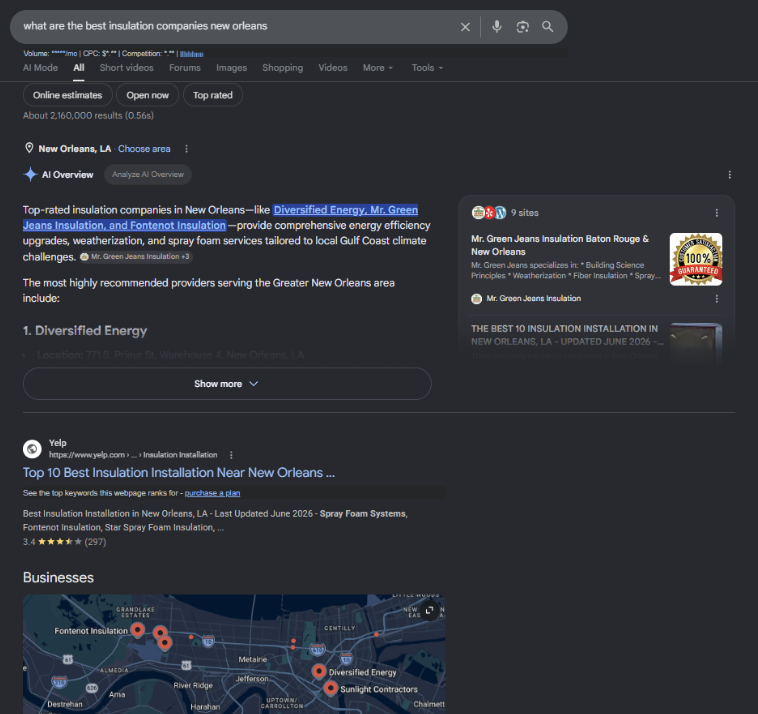
AI Overviews take up a looot of space on the first page of Google. Because of this, they push down other traditional organic listings, and in many cases, the local pack. In the example here, I’ve searched “what are the best insulation companies new orleans?”
That result at the top is an AI Overview. Think about this from a user’s perspective for a second. Would you scroll past that top result? Hmm, maybe not. It’s more likely that you’d click “Show more” for a list of insulation companies tailored to your specific search.
Beyond Google search, more and more people are turning to AI chatbots to learn about local services and products. I do think it’s important to put this in perspective, though. With over 100 billion monthly visits, Google.com is still the most visited website in the world as of mid-2026. Meanwhile, OpenAI’s ChatGPT.com is the fifth-most-visited website with over 5 billion monthly visits.
Yes, there’s still a big gap in demand, but comparing mid-2026 Year-over-Year (YoY) growth, 0.38% and 56.67% for Google and chatgpt.com, respectively, presents a different story. In my experience (and having talked to other competent SEOs), it’s about having a firm footing in the present while doing prep work for the “future of search.”
In short, as a local business owner, you want your content to appear in Google’s AI Overviews. And, when relevant, you want to appear in prospects’ searches within chatbots themselves. As I said earlier, we really don’t have to get DRAMATIC about any of this. Traditional SEO, slightly tweaked for AI search and external chatbots, is the answer.
FAQs
What Is SEO and Why Do I Need It?
SEO means “search engine optimization.” It is the practice of tailoring your website to match specific online searches from your ideal customers. Small and local businesses typically need SEO to help their ideal customers find their products or services online.
Can I Do SEO by Myself?
Yes, as a business owner, you can do SEO by yourself. But, in many instances, it is not recommended. For example, if you have a technical issue and don’t have the right experience, you could make it even worse. In that case, you will likely benefit from a technical SEO professional to identify the cause and fix it for you.
If You Don’t Need SEO? WTF SEO Will Actually Tell You!
A ton of businesses can and do benefit from professional SEO services. That said, not every business realistically needs SEO. If you’re a local business in New Orleans and you’ve heard you need this SEO thing, but you’re unsure? Get in touch with WTF SEO, and we will be 100% honest with you about whether your business will or won’t benefit from our services.
Not sure if your business actually needs SEO?
We’ll tell you straight — even if the honest answer is “you don’t need us.” No SEbrO tactics, no guarantees we can’t keep, no bridges for sale. Just a real conversation about whether SEO makes sense for your New Orleans business.
| Exploding Topics |
Howarth, Josh. “How Many Google Searches Are There Per Day?” Exploding Topics, 2026, explodingtopics.com/blog/google-searches-per-day. Accessed 2 July 2026. |
| Ahrefs |
Law, Ryan. “96.98% of Clicks Happen in the Top 10 Search Results.” Ahrefs, 22 Oct. 2025, ahrefs.com/blog/almost-all-clicks-happen-in-the-top-10-results. Accessed 2 July 2026. |
| HubSpot |
Nicholson, Rachael. “Improve Your SEO with These Best Practices and Expert Resources.” HubSpot, 3 June 2026, blog.hubspot.com/marketing/seo. Accessed 2 July 2026. |
| Backlinko |
“Rachel Nicholson — Content Writer.” Backlinko, backlinko.com/blog/authors/rachel-nicholson. Accessed 3 July 2026. |
| WTF SEO |
“Liam Fallen Interview: Reddit and LinkedIn Marketing.” WTF SEO, 2026, wtfseo.io/blog/liam-fallen-reddit-linkedin-marketing-interview. |
| Semrush |
“Most Visited Websites in the World.” Semrush, 2026, www.semrush.com/trending-websites/global/all. Accessed 2 July 2026. |
| Local Falcon |
“Whitepaper: The Impact of Google AI Overviews on Local Business Search Visibility.” Local Falcon, 21 May 2025, www.localfalcon.com/blog/whitepaper-studies-the-impact-of-google-ai-overviews-on-local-business-search-visibility. |